A lump at the anus, mucus, bleeding, leakage, or difficult bowel movements can result from several conditions, and the correct diagnosis determines whether rectopexy is appropriate. You will learn how doctors confirm rectal prolapse, compare abdominal and perineal operations, prepare for surgery, and assess a local surgeon before booking treatment.
Key takeaways
- Seek urgent care if prolapsed tissue cannot be pushed back or turns dark.
- Doctors confirm prolapse with examination and selected bowel tests.
- Rectopexy secures the rectum; technique choice depends on symptoms and anatomy.
- Ask about recurrence risk, constipation, recovery time, and alternative procedures.
How rectal prolapse feels—and when it needs urgent care
A full-thickness external prolapse produces a red, moist mass that comes through the anus, often while you strain, stand, or cough. It may retract at first, then remain outside; mucus, bleeding, faecal leakage, and a weak sense of control are common. The folds usually run in concentric rings because the entire rectal wall is protruding.
Internal intussusception stays inside the pelvis. You may feel pressure, repeated urges, incomplete emptying, stool blockage, or the need to press around the vagina or anus to evacuate, but no rectal tissue appears outside. Defecography can confirm this distinction when examination is inconclusive.
Prolapsing haemorrhoids are swollen vascular cushions, not the whole rectal wall. They tend to form separate lumps, with bright-red bleeding, itching, or soreness. Do not label any anal mass as haemorrhoids by appearance alone.
Treat a protruding prolapse as an emergency if it becomes trapped outside or turns dark purple, blue, or black. Seek emergency care for severe or increasing pain, heavy bleeding, fever, vomiting, abdominal swelling, or inability to pass stool or gas.
- Do not force a painful, stuck prolapse back inside.
- Arrange prompt examination for a new mass, persistent mucus or bleeding, leakage, or worsening constipation.
- If you are searching for rectal prolapse treatment near me, choose assessment that covers continence, constipation, and pelvic-floor symptoms—not just the visible lump.
How doctors confirm prolapse before recommending surgery
The diagnosis starts with history and an examination while you strain, not with a scan. The doctor inspects the anus for full-thickness tissue emerging through the opening, asks you to bear down on a commode or examination bed, and performs a digital rectal examination to assess sphincter tone, tenderness, blood, and associated lesions.
An anoscopy or proctoscopy can distinguish prolapse from haemorrhoids.
| Finding or question | Test that may follow | What it changes |
|---|---|---|
| External prolapse is not visible | Defecography, using X-ray or MRI while you evacuate contrast | Shows internal intussusception or pelvic-floor descent |
| Constipation, leakage, or weak squeeze | Anorectal manometry | Measures sphincter pressure and coordination |
| Bleeding, altered bowel habit, or screening due | Colonoscopy | Excludes polyps, cancer, inflammation, or another bleeding source |
| Slow, severe constipation | Colonic-transit study | Separates slow-transit constipation from outlet obstruction |
Laparoscopic rectopexy colo rectal for disorders in baner is not a diagnosis or an automatic treatment choice. It is mainly considered for confirmed full-thickness external prolapse and selected symptomatic internal intussusception after bowel-function assessment.
| Situation | Why rectopexy is the wrong first treatment |
|---|---|
| Haemorrhoids or isolated bleeding | Treat and investigate the actual cause |
| Constipation without proven prolapse | Address medicines, diet, transit, or pelvic-floor dyssynergia |
| Severe frailty or high anaesthetic risk | Compare perineal procedures and non-operative care |
A colorectal surgeon in Baner can assess whether rectal prolapse surgery in Baner is appropriate; location and a search phrase alone, including laparoscopic rectopexy colo rectal for disorders in baner, cannot establish suitability.
What happens during laparoscopic rectopexy and how techniques differ
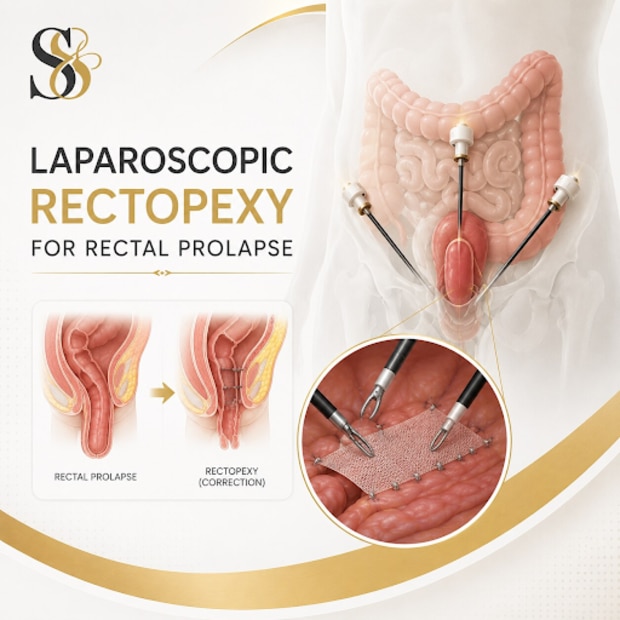
The operation is performed under general anaesthesia through several small abdominal ports. The surgeon frees the rectum within the pelvis, identifies the sacral or presacral fascia, and secures the rectum to restore support.
A search for laparoscopic rectopexy in Pune should lead to a discussion of bowel function, pelvic-floor findings, prior operations, and the surgeon’s experience with each technique.
- The surgeon inserts a camera and instruments through the ports.
- The rectum is mobilised to the extent needed for the chosen repair.
- Sutures or mesh attach the rectum to the sacrum or presacral fascia.
- If severe constipation accompanies a markedly redundant sigmoid colon, the surgeon may remove that segment and join the bowel ends with an anastomosis.
| Option | Effect on constipation | Recurrence and complications |
|---|---|---|
| Ventral mesh rectopexy | Often avoids the extensive posterior dissection linked with worsened constipation and helps preserve autonomic nerves. Existing constipation can still persist. | Prolapse can recur. Mesh can erode into the rectum or vagina, become infected, cause pain or fistula, and require further surgery. |
| Posterior suture rectopexy | Fixation after posterior mobilisation can worsen constipation, particularly in someone already struggling to empty the bowel. | Avoids mesh-specific problems, but carries risks of nerve, bladder, sexual, bowel, ureter, and blood-vessel injury; recurrence remains possible. |
| Resection-rectopexy | Removing redundant sigmoid colon may improve severe constipation and obstructed defecation in selected patients. | Adds bleeding, ileus, obstruction, and anastomotic-leak risks. It does not eliminate recurrence. |
All approaches also carry risks of infection and venous thromboembolism. Ask for the surgeon’s own recurrence, bowel-function, mesh, and complication data.
Choosing between rectopexy, Altemeier, and Delorme procedures
Age alone does not choose the operation. A fit older adult may still suit laparoscopic rectopexy, while a younger patient with severe heart or lung disease may need a perineal procedure to reduce anaesthetic risk.
| Option | Best fit | Main trade-offs |
|---|---|---|
| Laparoscopic rectopexy | Medically fit patients with full-thickness prolapse, especially when lower recurrence is a priority | General anaesthesia, abdominal ports and bowel preparation; recovery is longer than perineal surgery. Constipation can worsen after posterior mobilisation. Mesh techniques reduce dissection but carry risks of erosion, infection, pain, fistula and further surgery. |
| Altemeier | Older or frail patients, or a long external prolapse accessible through the perineum | Removes the prolapsed rectosigmoid through the anus, avoiding abdominal surgery. Recovery is usually quicker, but recurrence is higher and leakage or anastomotic problems can occur. |
| Delorme | Shorter, usually less bulky prolapse, particularly when abdominal anaesthesia is undesirable | Removes the prolapsed lining and folds the muscle underneath. It avoids bowel resection, but is less suitable for a long prolapse and can recur. |
Bowel function can change the choice. Treat constipation, slow-transit constipation or pelvic-floor dyssynergia before surgery when possible; rectopexy may not correct these problems and posterior techniques can aggravate constipation. Incontinence may improve after prolapse correction but can persist if the sphincter or nerves are damaged.
Ask how much bowel preparation is needed, whether resection might be added, expected admission and recovery, and the surgeon’s recurrence and complication rates. A search for rectal prolapse surgery in Baner identifies a location, not the safest operation.
Questions to ask a Baner surgeon before scheduling treatment
Geography does not establish suitability: a search for “colo rectal surgeon in baner” identifies a location, not colorectal expertise or a safe treatment plan. Check whether the clinician has training in colorectal surgery or advanced laparoscopic surgery, and whether the hospital can provide anaesthesia, imaging, intensive care, and emergency reoperation.
Ask these questions before booking:
- How many rectal prolapse operations do you perform each year, and which techniques do you use: ventral mesh rectopexy, posterior suture rectopexy, or resection-rectopexy?
- What findings make you recommend mesh, and what are your rates of mesh erosion, infection, chronic pain, fistula, and further surgery?
- If constipation or slow-transit disease makes bowel resection appropriate, could you decide that during the operation? Ask about anastomotic leak, stoma risk, and how the plan changes.
- How many nights will I stay, when can I walk and work, and which symptoms require an urgent return?
- What are your own rates of recurrence, bleeding, infection, bowel or urinary injury, ileus, obstruction, venous thromboembolism, urinary dysfunction, sexual dysfunction, and altered bowel function?
- What happens if prolapse recurs, and who pays for or performs follow-up treatment?
Ask for figures from the surgeon’s practice, not a hospital brochure. Dr. Shaunak Saha should also explain how your continence, constipation, pelvic-floor function, and test results affect the recommended operation.
Related service
Laparoscopic Rectopexy for Rectal Prolapse Laparoscopic Rectopexy for Rectal Prolapse Laparoscopic rectopexy is a surgical procedure used to treat rectal prolapse by restoring the rectum to a more appropriate position and securing it... View service → |
Frequently asked questions
How does full-thickness rectal prolapse feel?
A red, moist mass may emerge through the anus during straining, standing, or coughing. Mucus, bleeding, faecal leakage, and reduced control can occur. Concentric folds suggest that the entire rectal wall is protruding.
When does rectal prolapse need urgent care?
Seek urgent medical assessment if the prolapse remains outside, becomes severely painful, swells, bleeds heavily, or turns dark purple or black. These changes can indicate impaired blood supply.
How do doctors confirm rectal prolapse before surgery?
The surgeon examines the anus and rectum, sometimes while you strain or sit on a commode. Defaecography, colonoscopy, anorectal manometry, or imaging may be selected when constipation, bleeding, or another bowel disorder needs investigation.
What happens during laparoscopic rectopexy?
Through small abdominal incisions, the surgeon frees and lifts the rectum, then secures it to the sacrum or surrounding tissue. The operation may use sutures, mesh, or a resection of redundant sigmoid colon, depending on constipation and rectal anatomy.
How do rectopexy, Altemeier, and Delorme procedures differ?
Laparoscopic rectopexy approaches the rectum through the abdomen and suits many fit patients. Altemeier removes prolapsed rectum through the anus, while Delorme removes the mucosal layer and folds the muscle; both perineal procedures are commonly considered when abdominal surgery carries greater risk.
Keywords