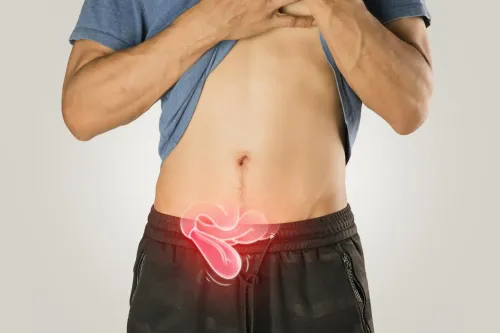
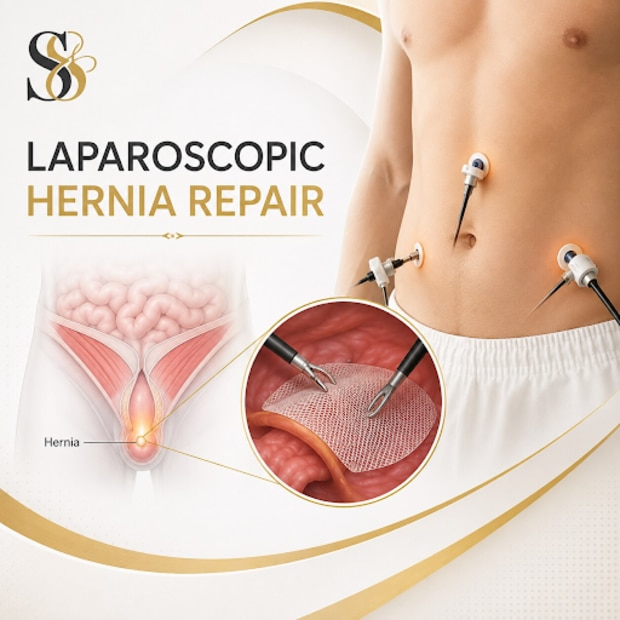
A new groin lump that is becoming painful needs more than a guess based on its appearance. You will learn which features point toward a hernia or another cause, when to seek emergency care, what an assessment involves, and how surgeons weigh repair against observation.
Key takeaways
- Seek same-day care for a painful, firm lump that will not reduce.
- Do not force a groin lump back or delay assessment as discomfort increases.
- Track when the swelling appears, changes size, and causes pain.
- Compare surgical advice, repair technique, anaesthesia, recovery, and follow-up.
Is the new groin swelling a hernia or something else?
A new groin lump cannot be diagnosed by appearance alone. Its size may change with standing, coughing, straining or lying down. A bulge that appears upright and reduces when you lie down fits a hernia, but this pattern does not prove it.
An inguinal hernia sits above the groin crease; a femoral hernia lies lower, nearer the upper thigh, and is easier to miss.
If you are searching for hernia repair for groin swelling discomfort in pune, consider other causes too:
- A hydrocele causes fluid-related swelling around the testicle, usually in the scrotum rather than a reducible groin bulge.
- An enlarged lymph node feels like a firm, discrete lump and may accompany a skin or leg infection.
- A lipoma is soft, fatty and usually stays present when you cough or change position.
- A muscle strain causes pain with movement but no clearly reducible lump.
- A testicular problem causes tenderness or swelling centred in the testicle.
- An abscess is painful, warm or red; a vascular swelling needs urgent assessment.
A surgeon examines you standing and lying down, asks you to cough when appropriate, checks whether the lump reduces, and looks for femoral involvement. Ultrasound helps when examination is inconclusive or the swelling is hidden. Severe or worsening symptoms still need assessment even after a normal scan.
Which groin-swelling symptoms require same-day emergency assessment?
A painful groin lump that becomes hard, tense, or impossible to push back needs same-day emergency assessment. Do not wait for an elective hernia appointment: trapped tissue can lose its blood supply and bowel obstruction can develop.
| Warning sign | Why it matters | What to do |
|---|---|---|
| Hard or irreducible lump | The hernia may be incarcerated | Attend emergency assessment today |
| Sudden, severe, or steadily increasing pain | Trapped bowel or tissue may be strangulating | Seek urgent surgical review |
| Vomiting or a swollen abdomen | These can signal bowel obstruction | Go to an emergency department |
| Inability to pass stool or gas | The bowel may be blocked | Seek immediate care |
| Fever | Infection or compromised tissue is possible | Arrange same-day assessment |
| Red, purple, dusky, or black skin over the lump | Blood flow may be failing | Treat it as an emergency |
| Pain with several of these signs | The risk is higher when symptoms cluster | Do not schedule routine repair |
Do not forcefully press a painful or firm swelling back into the abdomen, and avoid food or drink if emergency surgery seems possible until clinicians advise you. For hernia treatment in Pune, choose a service with access to emergency surgery, anaesthesia, ultrasound or computed tomography, and postoperative follow-up.
A normal scan must not override severe or worsening symptoms.
What should you do before a surgeon examines the lump?
Until a surgeon examines the lump, stop repeated coughing, straining, and breath-holding during bowel movements. Avoid lifting weights, heavy bags, or anything that increases groin pressure. Arrange an examination promptly rather than testing the swelling repeatedly.
- Do not forcefully press a painful, firm, or stuck swelling back into the abdomen. Stop and seek same-day surgical assessment if it becomes suddenly more painful, cannot be pushed back, or comes with vomiting, abdominal swelling, fever, skin colour change, or inability to pass stool or gas.
- Note when the lump appears, whether it enlarges while standing, coughing, or straining, and whether it disappears when you lie down. Do not delay care while trying to reproduce it.
- Take your medicines and relevant medical records to the appointment. Tell the clinician about constipation, urinary difficulty, previous abdominal operations, pregnancy, or a prior hernia.
If you are looking for a groin swelling surgeon in Baner, expect the examination to include inspection and gentle palpation while standing and lying down.
The clinician checks whether the lump is reducible, whether it follows the inguinal canal, and whether a femoral component, testicular problem, lymph node, hydrocele, lipoma, abscess, or another cause fits better.
Ultrasound helps when the swelling is hidden or the examination is inconclusive. CT may be useful for deeper, complicated, or recurrent cases. Imaging does not replace examination, and a normal scan does not make severe or worsening symptoms safe to ignore.
When is watchful waiting reasonable, and when does increasing discomfort favour repair?
Observation is reasonable for a man with a reducible, minimally symptomatic or symptom-free inguinal hernia after a surgeon explains the risks and arranges follow-up. It is not a cure: increasing discomfort, repeated interference with walking or work, or a bulge that becomes harder to reduce shifts the balance towards planned repair.
Sex and location matter. Women with groin hernias generally need timely repair because a femoral hernia is more likely and carries greater risk of incarceration or strangulation. A suspected femoral component deserves careful examination rather than prolonged observation.
Seek same-day surgical assessment if the swelling becomes:
- Hard or impossible to push back
- Suddenly painful or progressively more painful
- Associated with vomiting, abdominal swelling, fever, skin colour change, or inability to pass stool or gas
Emergency surgery carries more uncertainty than planned repair, including possible bowel resection. Do not wait for a routine appointment if these features appear.
Your recovery demands also influence timing. Repair may fit better before travel, heavy work, or caregiving responsibilities, but medical fitness and operating risks must be assessed first; heart or lung disease, blood-thinning medicines, obesity, diabetes, and previous abdominal operations can alter anaesthesia and surgical planning.
For hernia treatment in Pune, check access to anaesthesia, emergency surgery, ultrasound or CT, and postoperative review. If you are considering hernia repair in Pune, balance symptom progression against chronic pain, infection, mesh-related discomfort, recurrence, and the time you can safely take for recovery.
How should you compare hernia repair options and surgical care in Pune?
For hernia repair in Pune, compare the plan rather than the label “laparoscopic” or “robotic.” Ask how often the surgeon performs the proposed operation, which mesh is planned, where it will sit, how it will be fixed, and how recurrence and chronic pain are recorded after surgery.
| Approach | What to ask | When it may fit |
|---|---|---|
| Open anterior repair | Which mesh and fixation method will you use, and how will you limit nerve-related pain? | Primary unilateral hernia or recurrence after posterior repair |
| Laparo-endoscopic repair | Is the surgeon trained in this approach, and is suitable anesthesia and emergency support available? | Bilateral hernias or recurrence after a previous open repair |
| Robotic repair | What measurable benefit does it offer for this case over standard laparoscopy? | Only when its specific benefits justify added complexity or cost |
Ask these questions before scheduling:
- What anesthetic is planned, and what medical conditions could change that plan?
- If bowel is trapped or compromised, can the operation proceed to emergency treatment, bowel repair, or conversion to open surgery?
- When can you walk, drive, lift, exercise, and return to work?
- Who reviews wound problems, fever, persistent pain, or a recurrent bulge, and when is follow-up?
- Is ultrasound available for an uncertain lump, CT for deeper or complicated findings, and emergency surgery available without transfer?
A groin swelling surgeon in Baner should examine you standing and coughing or straining, assess reducibility, and check for femoral involvement; imaging does not replace that examination.
Dr. Shaunak Saha can use this evaluation to match the repair to your symptoms, prior operation, fitness, and access to timely follow-up rather than to a neighbourhood or technique label.
Related services
Hernia Surgery Open hernia repair is a surgical procedure used to treat a hernia through an incision made directly over or near the affected area. View service → |
Laparoscopic General Surgery A hernia occurs when internal tissue pushes through a weak area in the surrounding muscle or abdominal wall, creating a bulge or swelling. View service → |
Frequently asked questions
How can you tell whether new groin swelling is a hernia?
A bulge that appears while standing, coughing, or straining and reduces when lying down fits a hernia, but examination is needed because appearance alone cannot confirm the diagnosis.
Which groin-swelling symptoms need same-day emergency assessment?
Seek same-day emergency assessment for severe or rapidly increasing pain, a firm tender lump that will not reduce, vomiting, abdominal swelling, or inability to pass stool or gas.
What should you do before a surgeon examines a groin lump?
Avoid heavy lifting and straining, do not force the lump back, note when it appears and changes, and seek urgent care if pain, vomiting, or irreducibility develops.
When is watchful waiting reasonable for a groin hernia?
Watchful waiting can be discussed when the diagnosis is clear and symptoms are minimal, the lump reduces easily, and you have a plan for review and urgent warning signs.
How should you compare hernia repair options in Pune?
Ask about open versus laparoscopic repair, mesh use, anaesthesia, expected recovery, recurrence and pain risks, surgeon experience, hospital support, and follow-up arrangements.
Keywords