The right repair depends on the hernia’s location, size, recurrence history, your previous operations and whether you can safely undergo general anaesthesia. By the end, you will know when laparoscopic hernia repair is a sensible option, when open surgery deserves preference, and how to assess a surgeon and prepare for treatment.
Key takeaways
- Laparoscopic repair suits many adults with groin or recurrent hernias.
- TEP stays outside the abdominal cavity; TAPP enters it before mesh placement.
- Open repair may be safer for some large, complex, or medically high-risk hernias.
- Ask about the surgeon’s hernia experience, technique, mesh, risks, and recovery plan.
Which hernias and patients are suitable for laparoscopic repair?
A laparoscopic surgeon for hernia repair assesses the individual, not just the bulge. For hernia surgery for adults, the decision depends on:
- Location and defect size
- Pain, obstruction symptoms and whether the hernia reduces
- Obesity, previous abdominal operations and likely adhesions
- Heart, lung and other medical conditions affecting general anaesthesia
- Sex, pregnancy plans and any previous repair
A visible or palpable hernia does not automatically need imaging. Ultrasound or CT helps when examination is unclear, obesity limits assessment, the hernia has recurred, or another abdominal problem is suspected.
A painful irreducible bulge, vomiting, abdominal distension, fever, skin colour change, or inability to pass stool or gas requires urgent hospital assessment, not appointment booking.
| Hernia type | When laparoscopy may fit | Important counselling point |
|---|---|---|
| Adult inguinal or femoral | Primary or bilateral disease | Both sides can often be repaired through the same port sites; bilateral disease is a particularly practical use. |
| Umbilical | Selected defects after examination | Size, location, obesity and medical fitness influence the approach. |
| Incisional | Selected defects without prohibitive adhesions or contamination | Prior operations, adhesions, loss of abdominal domain and reconstruction needs matter. |
| Recurrent groin | Based on the first repair | After anterior open repair, posterior laparo-endoscopic repair usually uses the opposite plane; after posterior laparoscopic repair, anterior open repair is generally preferred. Pregnancy plans and sex also shape counselling. |
What happens in TEP, TAPP and mesh-based laparoscopic repair?
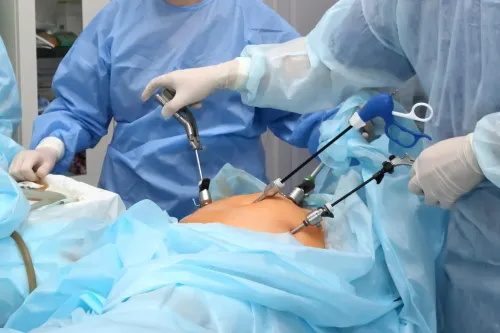
For an adult groin hernia, the surgeon makes small port incisions, develops a working space, reduces the hernia contents, and places mesh behind the abdominal wall. The mesh reinforces the weak area; it does not simply cover the visible lump. Dissection must protect the bladder, bowel, major blood vessels and nerves.
| Approach | What the surgeon does | Key distinction |
|---|---|---|
| TEP | Develops the preperitoneal space, reduces the hernia and places mesh there | Does not enter the abdominal cavity |
| TAPP | Enters the abdominal cavity, opens the peritoneum, reduces the hernia and places mesh in the preperitoneal plane | Requires closure of the peritoneum over the mesh |
TEP and TAPP are not interchangeable promises. The surgeon may choose between them according to your anatomy, previous operations, training and findings during surgery; conversion to open surgery remains a safety option.
Ask about the mesh material, size, position and fixation. Find out whether fixation uses absorbable tacks, permanent tacks, glue, sutures or no fixation, and how that choice affects pain, migration and recurrence risk.
Mesh lowers recurrence compared with suture-only repair in many adult repairs, but it does not eliminate recurrence, infection, seroma, chronic pain or later mesh treatment.
When is open repair safer or more suitable than laparoscopy?
Smaller incisions do not automatically make laparoscopic repair safer. For hernia surgery for adults, the better option depends on the hernia, anaesthesia risk and surgeon’s ability to perform both approaches.
| Option | Main advantage | Main trade-off |
|---|---|---|
| Laparoscopic groin repair | Less early pain, faster early function and one set of port sites for bilateral hernias | Usually requires general anaesthesia and abdominal access |
| Open repair | Avoids abdominal access and may use local or regional anaesthesia | Bilateral groin repair may require separate incisions and early recovery can be slower |
Laparoscopic surgery usually requires general anaesthesia because the abdomen must be inflated with carbon dioxide and the patient must remain still. That matters for an adult with serious heart or lung disease, frailty or another reason to avoid general anaesthesia. Open repair may be safer in that setting.
Small ports do not remove the risks of bleeding, infection, urinary retention, bowel, bladder or vascular injury, port complications, recurrence, chronic groin pain or mesh-related problems. Laparoscopy is not a guarantee of little pain or an immediate return to work.
Incarceration, strangulation, bowel obstruction, severe infection, loss of abdominal domain, extensive adhesions, complex prior abdominal surgery or a need for component separation may call for urgent open surgery or another reconstruction. None is a universal exclusion without examination.
For umbilical, incisional and ventral hernias, defect size, contamination, location, obesity and previous operations matter more than the word laparoscopic. A general laparoscopic surgeon who also performs open repair can recommend the safer approach.
What should you ask before surgery, and what does recovery involve?
Before consenting, ask which approach is proposed and why, and how often the surgeon performs that specific inguinal or ventral repair. Ask about experience managing recurrences, chronic pain and infection.
| Approach | Ask what it involves |
|---|---|
| Laparoscopic | TEP or TAPP, mesh plane, fixation and general anaesthesia |
| Open | Why it is safer, anaesthesia options and expected restrictions |
| Either | Whether conversion to open surgery is possible if safety requires it |
- Which mesh material, size and plane will be used, and will fixation use absorbable or permanent tacks, glue, sutures or no fixation?
- What are your recurrence, chronic-pain and infection outcomes for this repair?
Before laparoscopic hernia repair, provide a complete medication list. Disclose anticoagulants and diabetes treatment; follow the exact fasting instructions, and ask when to stop and restart blood thinners. Stop smoking as early as possible, complete indicated blood tests or imaging, and arrange transport plus help at home.
Keep wounds clean and follow the shower instructions. Walk early, avoid lifting until the surgeon’s stated restriction ends, and ask when desk work, driving, exercise and sex are safe for your operation and occupation. Large, recurrent or complicated repairs take longer.
Seek prompt review for:
- Fever, worsening pain, persistent vomiting, wound redness or discharge, or urinary retention
- Leg swelling, breathing difficulty, or a new irreducible bulge
Request an itemised estimate covering the hospital, mesh, anaesthesia, investigations, admission and possible complications, then obtain insurance pre-authorisation.
How can you choose the right hernia surgeon in Pune?
Start with credentials, not the word “laparoscopic.” For a hernia surgeon in Pune, verify medical registration with the National Medical Commission’s Indian Medical Register or Maharashtra Medical Council, general-surgery qualification, laparoscopic training, hospital privileges, access to an anaesthetist, emergency services, and postoperative review.
A laparoscopic surgeon for hernia repair title does not prove expertise in every repair. Ask how often the surgeon performs your proposed groin, femoral, umbilical, incisional or recurrent operation, and ask about recurrence, chronic pain, infection and conversion rates.
| Option | What it involves | What to verify |
|---|---|---|
| TEP | Mesh placement without entering the abdominal cavity | Experience with posterior groin repair |
| TAPP | Abdominal entry before placing mesh behind the abdominal wall | How the peritoneum is closed |
| Open | Direct access through an incision | Whether local or regional anaesthesia is suitable |
During consultation, the surgeon should examine you, explain why imaging is or is not needed, discuss anaesthesia and mesh plainly, describe a conversion-to-open plan, and provide written restrictions and follow-up arrangements.
In Baner, Pune, Dr. Shaunak Saha can assess an adult hernia and discuss whether open or laparoscopic repair fits your condition; the examination should determine candidacy.
Bring:
- Symptom duration, bulge changes and pain triggers
- Operation records, medication list, scans and reports
Compare the plan, safety support and communication—not only price or “laparoscopic.” Laparoscopic repair is an option, not an automatic upgrade.
Related services
Laparoscopic General Surgery A hernia occurs when internal tissue pushes through a weak area in the surrounding muscle or abdominal wall, creating a bulge or swelling. View service → |
Laparoscopic General Surgery Laparoscopic appendectomy is a minimally invasive operation to remove the appendix, most commonly when appendicitis requires surgical treatment. View service → |
Frequently asked questions
Which hernias and patients are suitable for laparoscopic repair?
Laparoscopic repair is commonly considered for suitable adults with groin hernias, bilateral hernias, or hernias that have returned after open repair. Your surgeon must assess the hernia’s size, location, previous operations, anaesthetic risk, and overall health before recommending it.
What happens in TEP, TAPP and mesh-based laparoscopic repair?
In TEP repair, the surgeon works in the space outside the abdominal cavity. In TAPP repair, the surgeon enters the abdominal cavity, reaches the groin through the peritoneum, and closes that layer after placing mesh. Both techniques use small incisions, a camera, and mesh to reinforce the weakened area.
When is open repair safer or more suitable than laparoscopy?
Open repair can suit patients who cannot safely undergo general anaesthesia, people with complex or very large hernias, and some patients with extensive abdominal operations or scar tissue. The safest approach depends on the hernia and your medical history, not on incision size alone.
What should you ask before surgery, and what does recovery involve?
Ask which technique the surgeon recommends and why, how many hernia repairs they perform, what mesh will be used, what happens if the anatomy differs during surgery, and when you can return to work, driving, exercise, and lifting. Recovery varies with the repair and your job, so obtain written restrictions and warning signs.
How can you choose the right hernia surgeon in Pune?
Choose a hernia surgeon in Pune who explains open, TEP, and TAPP options, reviews your scans and previous operations, discusses mesh and complications plainly, and provides a specific follow-up plan. Confirm the hospital’s emergency support and ask who will manage problems after discharge.
Keywords