Open Hernia Repair service image
Open Hernia Repair

Open hernia repair is a surgical procedure used to treat a hernia through an incision made directly over or near the affected area. A hernia occurs when tissue from inside the abdomen pushes through a weakened area of the abdominal wall, often causing a visible or palpable bulge and discomfort. Dr. Shaunak Saha provides evaluation and surgical treatment for patients with inguinal and other abdominal wall hernias. During consultation, the type, size and location of the hernia, symptoms, previous surgeries and overall health are assessed before selecting the appropriate surgical approach. During open hernia repair, the protruding tissue is returned to its appropriate position and the weakened area of the abdominal wall is repaired. Mesh reinforcement may be used when clinically appropriate to strengthen the repair and reduce the risk of recurrence. Open surgery may be particularly appropriate for certain larger, recurrent or complicated hernias and in situations where laparoscopic surgery is not the preferred approach. The choice between open and laparoscopic repair is made according to the individual patient's condition. SPECIFICATIONS Procedure: Open hernia repair Common conditions: Inguinal and selected abdominal wall hernias Surgical approach: Open surgery Assessment: Clinical examination and imaging when required Repair: Reduction of hernia contents and repair of the abdominal wall defect Mesh: May be used when clinically indicated Anaesthesia: Local, regional or general depending on the case Treatment planning: Individualised according to hernia type and patient health Recovery: Depends on the hernia, surgical technique and individual factors Follow-up: Postoperative wound and surgical review FREQUENTLY ASKED QUESTIONS Q: What is open hernia repair? A: Open hernia repair is an operation in which the surgeon accesses the hernia through an incision, returns the protruding tissue to its appropriate position and repairs the weakened abdominal wall. Q: Is mesh always required for open hernia surgery? A: No. Mesh is commonly used for many types of hernia repair, but whether mesh is appropriate depends on the type and characteristics of the hernia and the surgical technique. Q: Is open or laparoscopic hernia surgery better? A: Neither approach is universally better. The appropriate technique depends on the type and size of the hernia, previous surgery, overall health and other individual factors. Q: Can a hernia become an emergency? A: A hernia can occasionally become trapped and severely painful, which may require urgent surgical treatment. Sudden severe pain, a hard or irreducible swelling, vomiting or other concerning symptoms require urgent medical assessment. Have a persistent groin or abdominal swelling? Consult Dr. Shaunak Saha for a detailed hernia evaluation and discuss whether open hernia repair or another treatment approach is appropriate for you.

Pediatric Hernia Treatment and Surgery service image
Pediatric Hernia Treatment and Surgery

Pediatric hernia is a common surgical condition in which tissue from inside the abdomen can push through a weak or incompletely closed area, often producing a groin or abdominal bulge. In children, inguinal hernias are commonly related to developmental factors. Dr Shaunak Saha provides consultation and surgical evaluation for children with suspected hernia. Treatment is planned according to the child’s age, type of hernia, symptoms and clinical findings. Pediatric hernia repair may be performed using an open approach or laparoscopic keyhole surgery depending on the individual case. Children undergoing surgery are generally assessed carefully by the surgical and anaesthesia teams before treatment. SPECIFICATIONS: Condition: Pediatric hernia Common type: Inguinal hernia Patient group: Infants and children Assessment: Pediatric clinical examination Treatment: Surgical repair when indicated Approach: Open or laparoscopic Anaesthesia: Usually general anaesthesia Recovery: Often rapid in uncomplicated cases Follow-up: Postoperative review Parent support: Preoperative and postoperative guidance FREQUENTLY ASKED QUESTIONS: Q: What is a pediatric hernia? A: It is a hernia occurring in an infant or child, commonly presenting as a groin or abdominal bulge. Q: Does a child's hernia need surgery? A: Pediatric inguinal hernias generally require surgical repair because they do not usually close on their own and can carry a risk of complications. Q: Can pediatric hernia surgery be done laparoscopically? A: Yes. Laparoscopic keyhole repair may be an option for selected children. If your child has a groin or abdominal swelling that may be a hernia, consult Dr Shaunak Saha for timely pediatric surgical assessment.

Laparoscopic Hernia Repair service image
Laparoscopic Hernia Repair

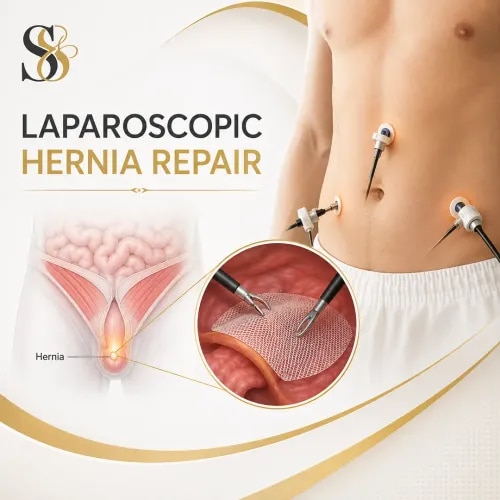
A hernia occurs when internal tissue pushes through a weak area in the surrounding muscle or abdominal wall, creating a bulge or swelling. Laparoscopic hernia repair uses small incisions, a camera and specialized instruments to repair the affected area. Dr Shaunak Saha provides evaluation and surgical consultation for patients with suspected inguinal, abdominal or other suitable hernias. The choice between laparoscopic and open repair depends on the type and location of the hernia, previous surgery, symptoms, overall health and other clinical factors. Depending on the hernia and surgical technique, reinforcement with surgical mesh may be considered. The appropriate repair method is determined after individual assessment. SPECIFICATIONS: Procedure: Laparoscopic hernia repair Conditions: Inguinal and selected abdominal hernias Approach: Minimally invasive keyhole surgery Assessment: Clinical examination and imaging when required Repair: Closure and reinforcement of the weakened area Possible reinforcement: Surgical mesh where clinically indicated Anaesthesia: Usually general anaesthesia Incisions: Small abdominal incisions Recovery: Individualised according to procedure and patient health Suitability: Determined by the surgeon FREQUENTLY ASKED QUESTIONS: Q: What are common signs of a hernia? A: A visible or palpable bulge in the groin or abdomen, discomfort or pain, particularly with coughing, lifting or straining, can occur. Q: Does a hernia go away on its own? A: A true abdominal wall hernia generally does not repair itself. Surgical treatment may be recommended depending on symptoms, type and risk. Q: Is laparoscopic hernia surgery suitable for everyone? A: No. The appropriate technique depends on the type of hernia, previous operations, health status and surgical assessment. Have a persistent groin or abdominal bulge evaluated by Dr Shaunak Saha and discuss the most appropriate hernia treatment for your condition.

Subcategory Tags

Hernia SurgeryAbdominal AbscessAbdominal HerniaAbscess DrainageAcute Abdominal PainAdult CircumcisionAnal Fissure SurgeryAnal Fissure TreatmentAnal Fistula SurgeryAnal Fistula TreatmentAnorectal Disorders,Anorectal SurgeryAppendicitis SurgeonAppendicitis TreatmentAppendix RemovalAppendix SurgeryBaby HerniaBreast Lump Evaluation,Breast Lump TreatmentBreast SurgeryBreast and Thyroid SurgeryChild Hernia SurgeryCircumcisionCircumcision SurgeryColorectal SurgeryCyst RemovalEndovenous TreatmentFacial Nerve SurgeryForeskin SurgeryGallbladder RemovalGallbladder SpecialistGallbladder SurgeryGallstone SurgeonGallstone TreatmentGanglion CystGeneral SurgeonGeneral SurgeryGroin HerniaGynaecological SurgeryHead and Neck SurgeryHemorrhoids TreatmentHepatobiliary SurgeryHernia TreatmentHernia Treatment PuneHydrocele RepairHydrocele SurgeryHydrocele TreatmentInguinal HerniaInguinal Hernia SurgeryInguinal Hernia in ChildrenKeyhole Hernia SurgeryKeyhole SurgeryLaparoscopic AppendectomyLaparoscopic CholecystectomyLaparoscopic Colorectal SurgeryLaparoscopic Hernia RepairLaparoscopic HysterectomyLaparoscopic Pediatric SurgeryLaparoscopic RectopexyLaparoscopic Splenectomy

Contact Us

Live Chat

Connect over WhatsApp to resolve your queries realtime.