The better operation depends on more than incision size: the hernia’s location, size, reducibility, previous operations, urgency and your ability to tolerate general anaesthesia all matter. By the end, you will know which findings can favour open repair, when laparoscopy remains reasonable, and what to ask before consenting to either approach.
Key takeaways
- Large, irreducible or scrotal hernias can make open repair more practical.
- Previous abdominal surgery can influence access and the preferred repair route.
- Emergency bowel involvement may require an open operation for safer access.
- Compare recovery, anaesthesia, complications and recurrence risks for your hernia.
Which hernia features can make open repair the more practical approach?
A very large, longstanding, irreducible hernia can make open repair more practical, especially when it extends into the scrotum or has loss of abdominal domain. The sac may be difficult to reduce through laparoscopic instruments, and forced dissection can injure bowel or nearby structures.
Open anterior repair gives direct access to selected inguinal and femoral defects.
| Approach | Access route | When it may fit |
|---|---|---|
| Open anterior | Incision directly over the groin defect | Selected inguinal or femoral hernias, including difficult scrotal hernias |
| Open preperitoneal | Mesh placed through an open incision behind the abdominal wall | Many small or moderate umbilical and epigastric hernias |
| TEP | Creates a preperitoneal working space without entering the abdominal cavity | Posterior repair when the plane can be reached and dissected safely |
| TAPP | Enters the abdominal cavity, then reaches the preperitoneal plane | Posterior repair when intra-abdominal access helps define the anatomy |
A defect hidden by scar, distorted anatomy, dense adhesions, or a prior mesh can also make safe laparoscopic dissection difficult. Obesity, size, or scrotal extension alone does not rule out laparoscopy; anatomy, defect complexity, and the surgeon’s experience determine whether minimally invasive reduction and mesh placement are sensible.
Loss of abdominal domain deserves particular caution: returning long-contained contents may sharply increase abdominal pressure and impair breathing or circulation. The operation must therefore match the space available, the contents involved, and the surgeon’s ability to reconstruct the abdominal wall safely.
When do an emergency or previous operation change the preferred route?
Rapid access becomes the priority when a hernia may be trapped or strangulated. Seek urgent assessment for:
- A bulge that cannot be pushed back
- Severe, persistent pain
- Vomiting
- Signs of bowel obstruction, such as abdominal swelling and inability to pass stool or gas
- A tender bulge
- Skin discoloration over the hernia
During emergency hernia repair, an open approach may give the surgeon the quickest route to the trapped contents, allowing rapid assessment of bowel viability and removal of dead or perforated bowel. That may require bowel resection in hernia surgery.
Diagnostic or therapeutic laparoscopy remains possible for selected stable patients when their anatomy and physiology permit it and the surgeon has the required expertise.
A previous repair changes the preferred tissue plane. After a posterior repair, usually TEP or TAPP, a recurrent inguinal hernia is generally approached through the anterior plane because scar tissue makes re-entering the posterior space harder. After a prior anterior repair, a posterior TEP or TAPP approach is commonly considered.
Radical prostatectomy deserves specific mention: it can scar the preperitoneal space, making open anterior repair attractive for a later groin hernia. Lower-abdominal or pelvic surgery, dense adhesions, prior mesh and radiation are planning factors, not automatic bans on laparoscopy. The surgeon weighs the scars, available planes and technical experience before choosing the route.
How do anaesthesia, pneumoperitoneum and patient factors affect the choice?
TEP and TAPP normally require general anaesthesia for laparoscopic hernia repair and carbon-dioxide pneumoperitoneum. The pressure can hinder ventilation and alter venous return and circulation, so open repair may be recommended even when laparoscopy is technically possible.
Selected open repairs allow local anaesthesia for open hernia repair or regional anaesthesia with sedation. This makes open surgery worth discussing when general anaesthesia or increased intra-abdominal pressure presents a concern; an anaesthetic assessment is essential, not a blanket rule for everyone with heart or lung disease.
| Option | Anaesthesia and pressure | Why it may matter |
|---|---|---|
| Open repair | Local or regional anaesthesia, with sedation when needed | Avoids pneumoperitoneum and may suit selected patients who should avoid general anaesthesia |
| TEP or TAPP | General anaesthesia with carbon-dioxide pneumoperitoneum | Requires tolerance of altered ventilation and circulation |
For women with groin hernias, guidelines generally favour laparo-endoscopic repair because it examines both groins and covers the femoral canal. Familiarity with open surgery alone is not a sufficient reason to choose it.
Obesity does not automatically favour open repair. Laparoscopy can reduce superficial wound problems, while open surgery may suit loss of domain, prior mesh or complex reconstruction. The decision depends on anatomy, reconstruction needs and anaesthetic assessment.
What happens during each operation, and what trade-offs should you compare?
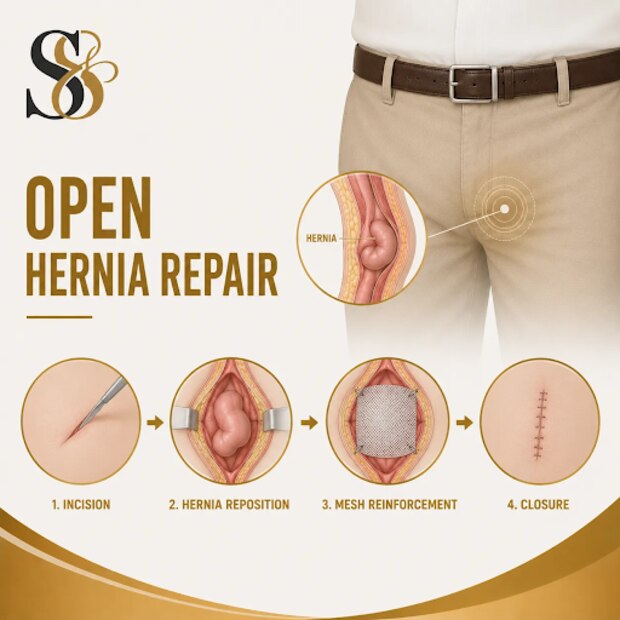
An open hernia repair procedure uses an incision over or near the defect. The surgeon separates the hernia sac carefully, returns protruding bowel or fat to the abdomen, then closes or reconstructs the weakened wall. Mesh placement depends on the hernia type, defect size, contamination and recurrence risk; contaminated fields may require a different repair.
Open access avoids entering the abdominal cavity and can be faster in an emergency, but wound recovery and chronic groin pain remain relevant risks.
- Laparoscopic TEP repair steps: place trocars, insufflate carbon dioxide, create a preperitoneal working space, reduce the sac and its contents, and position mesh behind the abdominal-wall defect when indicated. Preperitoneal dissection can injure vessels, nerves or surrounding structures.
- Laparoscopic TAPP repair steps: place trocars, enter the abdomen with carbon dioxide insufflation, open the peritoneum to reach the preperitoneal plane, reduce the sac and contents, and secure mesh behind the defect before closing the peritoneal layer. Abdominal entry and trocar placement carry uncommon injury risks.
| Option | Main advantages | Main trade-offs |
|---|---|---|
| Open repair | Direct access; local or regional anaesthesia may be possible | Incisional wound problems and chronic groin pain |
| Laparo-endoscopic repair | Experienced inguinal repair generally has comparable recurrence outcomes and less chronic postoperative pain | General anaesthesia, specialised equipment and advanced dissection |
| Either approach | Mesh can reinforce a suitable defect | Neither method is universally safer; anatomy, contamination and surgeon experience determine risk |
How should you and the surgeon reach an operation-specific recommendation?
Base the recommendation on the hernia’s anatomy, reducibility, bowel involvement, previous operations and your anaesthetic risk—not on the label “open” or “laparoscopic.” Ask these questions during your hernia surgery consultation:
- Which exact hernia type and plane do you recommend, and is the defect better reached from the front or behind?
- Is it reducible, and is bowel trapped, obstructed or at risk of needing resection?
- How do previous mesh, radiation, lower-abdominal surgery, dense adhesions or radical prostatectomy alter access?
- How do cardiopulmonary disease, body habitus and the risks of general anaesthesia or pneumoperitoneum change the plan?
- How often do you perform this specific operation? Do you have TEP or TAPP equipment, and can you convert to open surgery?
- If findings change, what is the plan for mesh, contamination or bowel resection?
| Option | What it offers | Questions to resolve |
|---|---|---|
| Open repair | Direct anterior or preperitoneal access; selected cases can use local or regional anaesthesia | Wound recovery, chronic pain and reconstruction plan |
| TEP or TAPP | Posterior access; TEP avoids the abdominal cavity, while TAPP enters it | General anaesthesia, pneumoperitoneum, equipment and surgeon experience |
A technically possible laparoscopic operation is not automatically the best operation, and an open recommendation does not prove laparoscopy is unsafe. Dr. Shaunak Saha can connect these questions to examination and a tailored open versus laparoscopic hernia repair decision for hernia repair in Baner Pune.
Related services
Hernia Surgery Open hernia repair is a surgical procedure used to treat a hernia through an incision made directly over or near the affected area. View service → |
Laparoscopic General Surgery A hernia occurs when internal tissue pushes through a weak area in the surrounding muscle or abdominal wall, creating a bulge or swelling. View service → |
Frequently asked questions
Which hernia features can make open repair more practical?
A very large, longstanding, irreducible or scrotal hernia, especially with loss of abdominal domain, can make open access more practical.
When can an emergency change the preferred hernia repair route?
Suspected strangulation, bowel obstruction, perforation or damaged bowel can require urgent open access to assess and treat the affected organs.
How can previous surgery affect the choice between open and laparoscopic repair?
Previous abdominal operations can leave adhesions or alter anatomy, making laparoscopic entry and dissection more difficult or risky.
How do anaesthesia and pneumoperitoneum affect the decision?
Laparoscopy requires general anaesthesia and carbon dioxide pneumoperitoneum; breathing, heart or pressure-related concerns can affect suitability.
What should you compare before choosing a hernia operation?
Compare access, mesh position, anaesthesia, recovery, wound risks, chronic pain, recurrence and the likelihood of needing bowel treatment.