Appendicitis can begin with vague stomach pain and progress quickly to severe pain, infection, or perforation. Knowing which symptoms need urgent assessment, how treatment choices are made, and what recovery requires helps you prepare for a safer decision and recognise problems after discharge.
Key takeaways
- Seek urgent assessment for worsening right-sided abdominal pain, vomiting, fever, or a rigid abdomen.
- Doctors combine examination, blood tests, urine tests, and imaging to confirm appendicitis.
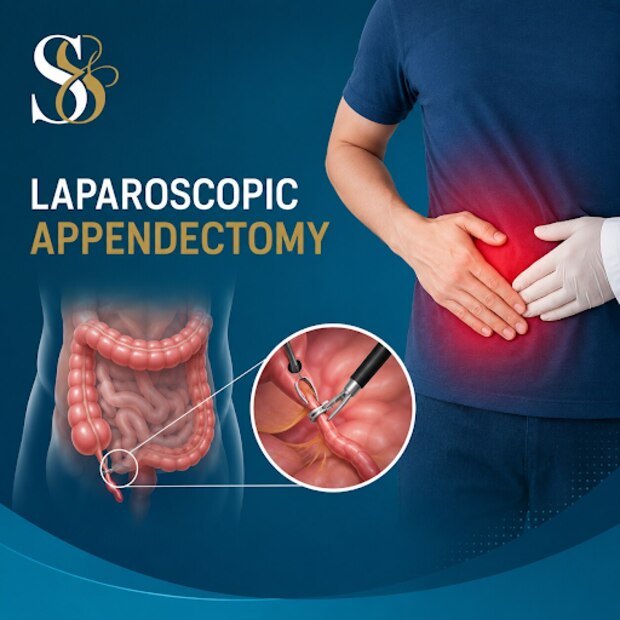
- Laparoscopic appendectomy uses small incisions under general anaesthesia to remove the appendix.
- Do not drive until you can brake safely and take prescribed pain medicine without impairment.
Which appendicitis symptoms need urgent medical assessment?
Appendicitis symptoms often begin with pain near the navel that moves toward the right lower abdomen. The pain may become severe, constant, or worse when you walk, cough, or press the area. Nausea and vomiting, fever and loss of appetite can occur, but not everyone develops the full pattern.
| Symptom pattern | What it can include | What you should do |
|---|---|---|
| Typical progression | Pain shifting to the right lower abdomen, nausea and vomiting, fever and loss of appetite | Seek urgent medical assessment |
| Less typical presentation | Diarrhoea, constipation, bloating, or pain that stays in another abdominal area | Arrange prompt assessment; do not dismiss it as a stomach bug |
| Concerning change | Severe pain, pain that keeps worsening, repeated vomiting, faintness, or inability to drink | Go to an emergency department |
Do not wait at home for severe or worsening abdominal pain to settle. Avoid laxatives, which can intensify cramping and delay assessment, and do not rely on repeated pain-masking self-treatment to decide that the problem has improved.
A normal appetite does not safely rule out appendicitis. Neither does the absence of fever. Symptoms vary with age, pregnancy, the appendix’s position, and whether perforation or another complication has developed, so a clinician’s examination and testing are safer than judging the pattern at home.
How is appendicitis confirmed, and when is surgery the right choice?
Appendicitis diagnosis starts with an abdominal examination: tenderness, guarding, and the pain pattern are weighed with your history, not treated as proof alone. Clinicians then use blood tests and urine test, followed by ultrasound or CT scan when the diagnosis remains uncertain or complications are suspected.
- Examination looks for localised tenderness, rigidity, dehydration, and signs of spreading infection.
- Blood tests can support inflammation or infection but cannot confirm appendicitis alone.
- A urine test helps identify urinary infection or blood suggesting a kidney stone.
- Ultrasound can assess the appendix and pelvic organs; CT gives clearer detail when ultrasound is inconclusive or perforation is suspected.
These findings help distinguish appendicitis from gastroenteritis, urinary infection, kidney stones, ovarian conditions, pregnancy-related emergencies, and other causes of abdominal pain.
For imaging-confirmed uncomplicated appendicitis, antibiotics versus appendectomy is a discussion for selected adults. Observation or no operation is not the same as cure: in the CODA trial, 29% of antibiotic-treated patients had an appendectomy within 90 days, with higher risk when an appendicolith was present.
An abscess or inflammatory mass may be treated first with antibiotics, drainage, and observation rather than immediate surgery. Recurrence counselling is essential; reported recurrence is about 12% to 24%, and adults aged 40 or older may need interval imaging or colon evaluation.
Dr. Shaunak Saha can help weigh the scan findings, anaesthetic fitness, recurrence concerns, and urgency instead of treating antibiotics as a permanent substitute for surgery.
Related service
Laparoscopic General Surgery Laparoscopic appendectomy is a minimally invasive operation to remove the appendix, most commonly when appendicitis requires surgical treatment. View service → |
What happens before and during laparoscopic appendix removal?
Before laparoscopic appendectomy, you will be asked when you last ate or drank; fasting reduces aspiration risk under general anaesthesia. The team reviews medicines, allergies, previous operations, and pregnancy possibility, orders a pregnancy test when relevant, explains risks and alternatives, obtains consent, starts intravenous fluids, gives antibiotics before the incision, and completes an anaesthesia assessment.
1. Under general anaesthesia, the surgeon makes a small incision at or near the navel and two small lower-abdominal port sites. Carbon dioxide inflation creates working space; a camera guides instruments that free, seal, and remove the appendix.
2. The team checks the abdomen and closes the port wounds with sutures, clips, or dressings. Perforated appendix surgery can become more extensive when the appendix is gangrenous, pus or an abscess is present, or infection has spread through the abdomen.
The surgeon may wash out contamination, remove infected tissue, prescribe postoperative antibiotics, and keep you in hospital longer.
3. A drain is not automatic. It is reserved for a selected abscess, possible leak, or residual contamination. If bleeding, adhesions, severe inflammation, an abscess, unclear anatomy, or poor visibility makes laparoscopy unsafe, conversion to an open operation may be safest. This changes incision size and recovery time, not the treatment goal.
What is recovery like after uncomplicated or complicated surgery?
Small wounds do not make laparoscopic appendectomy recovery pain-free. Incision soreness, temporary nausea, reduced appetite, constipation, and shoulder or upper-abdominal discomfort from residual carbon dioxide are common.
Walking and multimodal pain relief support recovery. Prescribed non-opioid medicines, such as paracetamol or ibuprofen when suitable for you, often control postoperative pain; short-term opioid rescue medicine may be needed.
- Walk for short periods as soon as your team permits; movement helps circulation and bowel function.
- Sip water or oral rehydration fluids, then advance from light foods to your usual diet as nausea and appetite improve.
- Ask how to prevent constipation, especially if you received an opioid; fluids, walking, and a prescribed laxative may help.
- Confirm that pain and nausea are controlled, you can drink and urinate, your vital signs are stable, and follow-up is reliable before same-day discharge.
Uncomplicated cases may allow same-day discharge or a short overnight stay. Perforated appendicitis recovery takes longer when perforation, abscess, peritonitis, conversion to open surgery, or another complication requires admission and postoperative antibiotics.
Compared with open surgery, laparoscopy usually offers these recovery advantages:
| Laparoscopy | Open surgery |
|---|---|
| Less wound pain | More incision pain |
| Fewer wound infections | Higher wound-infection risk |
| Shorter admission | Longer admission |
| Faster return to activity | Slower activity recovery |
The risk of an intra-abdominal abscess is broadly comparable between approaches, so smaller skin incisions do not remove deeper infection risk.
When can you drive, work, exercise, and seek help after discharge?
Light activity often resumes within days, but substantially normal activity commonly takes one to three weeks after an uncomplicated appendectomy. The word laparoscopic does not set a fixed timetable; perforation, abscess, conversion to open surgery, or other complications can extend recovery.
For driving after surgery, wait until you can sit, turn, check blind spots, and brake firmly without pain, and you are no longer taking sedating opioid medicine. Follow your surgeon’s instructions and local law.
Planning return to work after appendectomy depends on pain, mobility, wound condition, and job demands; desk work may come before lifting or physical work. Exercise and lifting restrictions end when movement is comfortable and your surgeon allows it.
Seek urgent medical advice for these appendectomy warning signs:
- Worsening abdominal pain rather than steady improvement
- Persistent vomiting or inability to drink
- Fever
- Increasing wound redness or drainage
- Abdominal swelling
- Faintness or breathing difficulty
- Inability to pass urine
Once healed, most people need no special long-term diet or activity restriction. During recovery, drink fluids, advance food gradually, walk regularly, and prevent constipation caused by anaesthesia or opioid medicines.
If an abscess or inflammatory mass was treated without immediate surgery, recurrence is commonly reported at about 12% to 24%. Keep follow-up appointments; adults aged 40 or older may need interval imaging or colon evaluation.
Frequently asked questions
Which appendicitis symptoms need urgent medical assessment?
Seek urgent medical assessment for abdominal pain that moves to the right lower abdomen, becomes constant or severe, or worsens with movement, coughing, or pressure. Fever, vomiting, loss of appetite, a swollen or rigid abdomen, confusion, or fainting also need prompt attention.
How is appendicitis confirmed?
Assessment combines your symptom history, abdominal examination, blood tests, urine testing, and imaging such as ultrasound or CT when needed. Doctors also consider other causes of abdominal pain before recommending treatment.
When is surgery the right choice for appendicitis?
Laparoscopic appendix removal is commonly recommended when appendicitis is confirmed, particularly when the appendix has perforated, formed an abscess, or caused peritonitis. Your surgeon will discuss antibiotics, drainage, or delayed surgery when those options fit your findings.
What is recovery like after laparoscopic appendix removal?
After uncomplicated surgery, you may go home once you can drink, walk, urinate, and control pain with oral medicine. Recovery takes longer after a perforated appendix, abscess, infection, or open surgery, which can require antibiotics and hospital monitoring.
When should you seek help after discharge?
Contact your surgical team for increasing pain, persistent vomiting, fever, spreading redness, pus or foul-smelling drainage, wound separation, inability to eat or drink, or worsening abdominal swelling. Seek emergency care for severe pain, breathing difficulty, fainting, or confusion.