Choosing between observation, medication, uterine surgery and ovarian surgery depends on what is causing the problem, how imaging looks, and whether fertility or ovarian function matters to you. By the end, you will understand what each operation changes, when it is worth considering, and which benefits and trade-offs to discuss before consenting.
Key takeaways
- A hysterectomy always removes the uterus and ends pregnancy permanently.
- Keeping the ovaries usually avoids immediate surgical menopause.
- Many simple ovarian cysts can be monitored instead of removed.
- Confirm which organs will be removed before consenting to surgery.
What a Hysterectomy Removes—and Which Type Is Planned
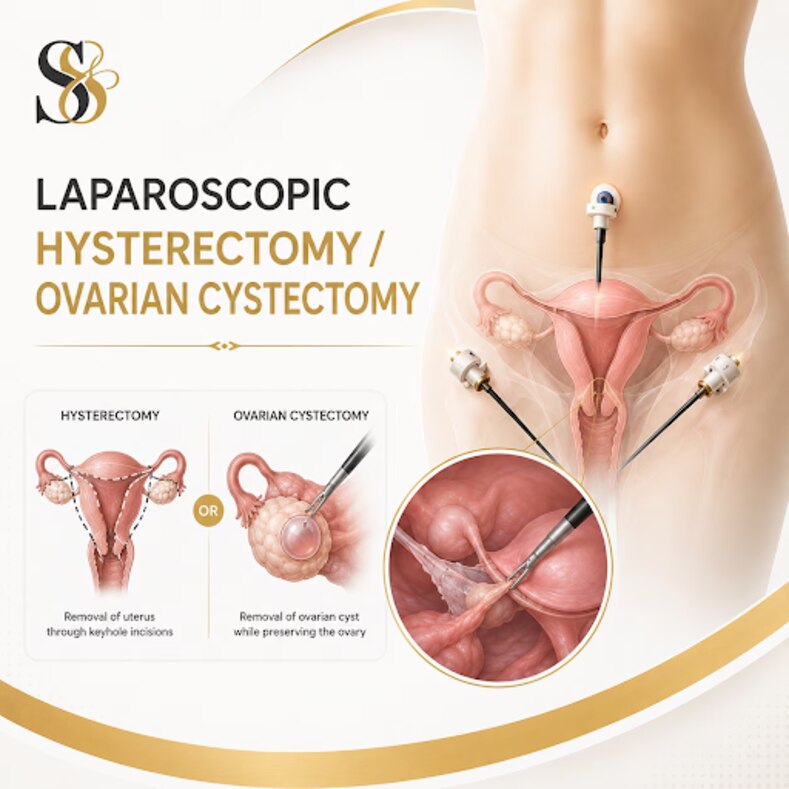
Every hysterectomy removes the uterus. It permanently ends menstrual bleeding and the ability to carry a pregnancy, whether the ovaries remain or not. The cervix, fallopian tubes and ovaries require separate decisions; they are not automatically removed because the operation uses a laparoscope.
| Type | What is removed | What remains |
|---|---|---|
| Total hysterectomy | Uterus and cervix | Fallopian tubes and ovaries unless separately removed |
| Subtotal hysterectomy, also called supracervical hysterectomy | Uterus | Cervix, fallopian tubes and ovaries unless separately removed |
| Radical hysterectomy | Uterus, cervix, surrounding tissues and usually the upper vagina | Tubes and ovaries only if the cancer plan allows them to remain |
Keeping the cervix means you continue cervical screening according to your clinician’s advice and local guidance. Keeping functioning ovaries can preserve hormone production, so removing the uterus alone does not cause immediate surgical menopause; removing both ovaries does.
A laparoscopic approach uses small abdominal incisions, but hysterectomy remains major surgery involving anaesthesia, bleeding risk, organ injury and recovery restrictions. Dense adhesions, difficult anatomy, heavy bleeding or suspected cancer can require conversion to an open operation.
The planned extent matters more than the word “laparoscopic”: confirm exactly which organs and tissues will be removed, what will remain, and why.
When Hysterectomy Is Appropriate—and When It Is Not the First Choice
Hysterectomy is appropriate when a uterine condition causes severe, persistent symptoms, has resisted other treatment, or threatens health; it is not the automatic first choice for every diagnosis.
| Condition | When hysterectomy can be justified | Uterus-preserving option to consider first |
|---|---|---|
| Fibroids or heavy menstrual bleeding | Large fibroids, severe anaemia, organ pressure or failed treatment | Medication, a levonorgestrel intrauterine device, myomectomy or uterine artery embolisation |
| Adenomyosis or endometriosis | Persistent pain or bleeding despite treatment; endometriosis treatment may require surgery | Hormonal medication or targeted excision when preserving fertility matters |
| Uterine prolapse | Advanced prolapse, organ damage or unsuccessful conservative care | Pelvic-floor therapy, a pessary or reconstructive surgery |
| Precancerous changes or cancer | The safest treatment may require removing the uterus, based on biopsy, stage and recurrence risk | Specialist surveillance or local treatment for selected precancerous changes |
Medication or a levonorgestrel intrauterine device may control heavy menstrual bleeding without removing the uterus. Endometrial ablation treats selected bleeding when you do not want a future pregnancy, but it is not suitable for every uterine shape or suspected cancer.
Myomectomy removes fibroids while preserving the uterus, while uterine artery embolisation shrinks some fibroids without major uterine surgery. These treatments can fail or allow symptoms to return.
Compare expected symptom relief, recurrence risk, fertility goals and recovery time—not incision size alone. Cancer, failed previous treatment, severe symptoms, large fibroids, anaemia or organ damage can shift the balance toward definitive treatment.
Ovaries, Surgical Menopause and Permanent Consequences
Removing both ovaries causes immediate surgical menopause, regardless of age. Hot flushes, night sweats, sleep disruption and vaginal dryness can begin quickly, while reduced oestrogen can affect bone strength and cardiovascular health. If functioning ovaries remain, hysterectomy itself does not immediately stop ovarian hormone production, although ovarian function can decline earlier in some premenopausal patients.
| Procedure | Structure removed | Main consequence |
|---|---|---|
| Hysterectomy | Uterus | Permanently prevents pregnancy and menstrual bleeding |
| Salpingectomy | Fallopian tubes | Prevents the tubes from carrying an egg |
| Oophorectomy | One or both ovaries | Reduces or stops ovarian hormone production |
Ovary removal is permanent, and ovarian preservation matters for hormones, bone health and fertility planning. Fertility after hysterectomy is not possible because you cannot carry a pregnancy, even when the ovaries remain; discuss egg freezing before surgery if future genetic parenthood matters.
Ask why each structure needs removal, whether hormone therapy is suitable, and what cervical screening you will still need if the cervix remains.
Preservation may be unsuitable when cancer risk, ovarian disease or age changes the balance. Before consenting, confirm:
- Whether the plan includes ovarian preservation or ovary removal
- Whether one or both ovaries require removal
- Whether hormone therapy is appropriate after bilateral removal
- Whether cervical screening continues after the planned hysterectomy subtype
Which Ovarian Cysts Need Surgery—and Which Can Be Watched
A simple functional ovarian cyst in a premenopausal patient often disappears without treatment. Repeat ultrasound and symptom monitoring are safer than an operation when the cyst is small, uncomplicated and shrinking.
Surgery becomes more relevant when a cyst persists, grows, is large, causes pelvic pain or pressure, or appears complex. Torsion, rupture, bleeding, endometriosis or suspected malignancy also changes the balance. Laparoscopic ovarian cystectomy is useful when imaging suggests a benign mass that can be removed safely.
Ultrasound findings that need careful assessment include:
- Solid areas
- Thick septations
- Papillary projections
- Irregular walls
- Ascites
- Concerning blood-flow patterns
These findings do not mean automatic cystectomy. If ultrasound cannot answer the clinical question, MRI or CT may provide further detail. A large mass, extensive adhesions, difficult anatomy or cancer concern may require open surgery or referral for an oncologic procedure.
| Option | What it removes | Main treatment aim |
|---|---|---|
| Ovarian cystectomy | The cyst, while retaining the ovary | Preserve ovarian tissue, hormone production and fertility potential |
| Oophorectomy | Part or all of the ovary | Treat disease when preserving the ovary is unsafe or impractical |
Endometrioma surgery can reduce pain and recurrence more effectively than drainage, but it can also lower ovarian reserve. Discuss this trade-off carefully with bilateral disease, repeat operations or planned fertility treatment. Even cystectomy carries risks such as bleeding, infection and injury to nearby organs.
Laparoscopic Benefits, Limits and the Decisions to Confirm Before Surgery
Laparoscopic hysterectomy benefits include smaller incisions, less postoperative pain, lower blood loss in many cases, shorter hospitalisation and a faster return to routine activities than open abdominal hysterectomy. It remains major surgery, not automatically the safest option for every patient.
| Approach | Common advantage | Important trade-off |
|---|---|---|
| Laparoscopic | Smaller wounds, shorter hospital stay and faster recovery | Higher urinary-tract injury risk than abdominal hysterectomy in evidence comparisons |
| Open abdominal | Direct access for large masses, dense adhesions or difficult anatomy | Larger incision, more pain and longer recovery |
Both approaches, and ovarian cystectomy, carry surgical risks: bleeding, infection, blood clots, bowel, bladder, ureter or blood-vessel injury, anaesthetic complications and further surgery. A large mass, dense adhesions, difficult anatomy or suspected malignancy can make open surgery conversion safer; suspected cancer may instead require referral for cancer surgery.
Conversion is a safety decision, not proof that planning failed.
Laparoscopic ovarian cystectomy recovery can feel quick, but internal healing takes longer than the skin wounds suggest. After hysterectomy, avoid vaginal intercourse, tampons and anything placed in the vagina until your surgeon confirms healing.
Before consenting, ask about:
- Which structures will be removed, and whether the uterus can be preserved
- Whether the ovaries can remain and how ovarian tissue will be protected
- The chance of open surgery conversion and the plan if cancer is suspected
A consultation with Dr. Shaunak Saha in Baner, Pune can help you review imaging and these decisions before surgery.
Related service
Laparoscopic Gynaecological Surgery Laparoscopic Hysterectomy / Ovarian Cystectomy Laparoscopic hysterectomy is a minimally invasive surgical procedure for removing the uterus, while laparoscopic ovarian cystectomy involves... View service → |
Frequently asked questions
What does a hysterectomy remove?
Every hysterectomy removes the uterus. The cervix, fallopian tubes and ovaries require separate decisions and are not automatically removed.
When is hysterectomy appropriate?
It may be appropriate for conditions such as cancer, severe bleeding, fibroids or persistent pain when other treatments have failed or are unsuitable. It is not usually the first choice for every uterine problem.
What happens if the ovaries are removed during hysterectomy?
Removing both ovaries causes permanent loss of ovarian hormone production and surgical menopause. Keeping functioning ovaries usually avoids immediate surgical menopause.
Which ovarian cysts need surgery?
Surgery is considered for cysts that persist, enlarge, cause significant symptoms, look suspicious on imaging or create complications such as torsion. Many simple cysts can be monitored.
What are the benefits and limits of laparoscopic surgery?
Laparoscopic surgery uses small abdominal incisions and can reduce wound size and recovery time. It is not suitable for every patient, cyst or complex operation, so the surgical plan and possible conversion to open surgery should be confirmed beforehand.