A lump beside the anus that swells, drains, settles and returns deserves more than repeated home treatment. By the end, you will know how a fistula differs from an abscess and other common problems, which warning signs need urgent care, what an examination involves and why treatment depends on the tunnel’s path.
Key takeaways
- Repeated swelling and drainage can indicate a fistula after an anal abscess.
- Seek urgent assessment for fever, severe pain, spreading redness, or difficulty passing urine.
- Examination and scans map the tunnel’s path and its relationship to sphincter muscles.
- Treatment depends on the fistula’s anatomy, cause, and amount of sphincter muscle involved.
Why the same lump keeps swelling and draining
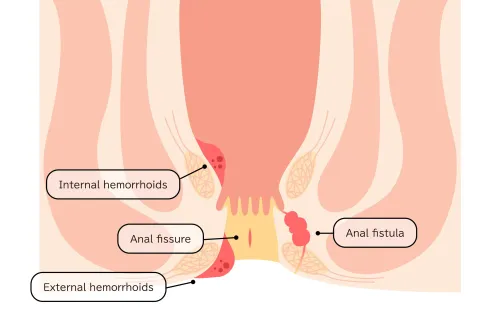
An anal fistula is an abnormal tunnel connecting the anal canal or rectum to the skin near the anus. It usually forms after an infected anal gland creates a perianal abscess. The abscess can burst by itself or be opened and drained, but that treatment does not necessarily remove the tunnel.
The pattern is often predictable: a recurring swelling near anus becomes tender and painful, then breaks open with pus or blood drainage. The lump shrinks and discomfort eases, but the opening may continue to leak, leaving wetness or irritated skin.
After days or weeks, the same recurrent lump swells again because the internal passage still connects the skin to the anal canal or rectum.
Repeated swelling and drainage in one spot therefore points toward an anal fistula more strongly than a single episode does. It is not proof. A painful, fluctuant lump may still be an abscess that needs prompt assessment, and fever is not required for either an abscess or fistula.
Do not identify the cause from photographs alone. An opening near the anus can result from several conditions, and the skin opening does not show whether a tunnel exists or how deeply it runs. A clinician needs to examine the area and decide whether further assessment is necessary.
How a fistula differs from an abscess, haemorrhoid and cyst
A perianal abscess is usually a single episode: a painful, tender swelling builds, then improves after it drains or is treated. An anal fistula is more suspicious when the same spot repeatedly swells, releases pus or blood, and settles without truly healing; a small opening, persistent wetness or foul-smelling discharge supports that pattern.
| Condition | Clues that point away from a fistula |
|---|---|
| Perianal abscess | Rapidly increasing pain, warmth and swelling suggest a trapped infection. Drainage may relieve pressure, but an abscess can exist without fever. |
| Thrombosed haemorrhoid | A sudden, intensely painful blue or purple lump sits at the anal edge. It does not usually produce recurring pus from a skin opening. |
| Anal fissure | Sharp or burning pain during and after a bowel movement, with bright-red blood on toilet paper, points to a tear rather than a draining tunnel. |
| Infected skin cyst | A tender lump with a central pore lies in the skin and may discharge thick material. It is separate from the anal canal. |
| Pilonidal sinus | Midline pits or an abscess in the upper buttock cleft indicate pilonidal disease, not an opening beside the anus. This is the key distinction in pilonidal sinus versus anal fistula. |
Location alone cannot confirm the diagnosis: fistula tunnels can run deeper than the visible opening. Seek urgent assessment for severe or worsening pain, rapidly spreading redness, difficulty urinating or feeling unwell. Do not squeeze the area or rely on photographs to diagnose it.
When drainage needs urgent assessment
A painful, enlarging lump needs same-day medical assessment, even without fever. An abscess can sit beneath the skin and require surgical drainage; antibiotics alone usually do not clear an abscess in an otherwise healthy person.
Seek urgent help today if you have:
- Fever and chills, faintness, confusion, or a strong feeling of illness
- Rapidly increasing anal pain or a swelling that is becoming tense
- Spreading redness, warmth, or swelling around the anus or buttocks
- Difficulty passing urine or stool
- Diabetes, impaired immunity, or treatment with medicines that suppress immunity
| Urgency | Signs | What to do |
|---|---|---|
| Emergency assessment now | Severe pain with feeling very unwell, confusion, faintness, or inability to pass urine | Go to an emergency department; do not wait for a routine appointment |
| Same-day assessment | Fever and chills, rapidly increasing anal pain, spreading redness, or a painful enlarging lump | Contact an urgent-care service or surgical clinic today |
| Prompt appointment | Ongoing drainage, a nonhealing opening, or a lump that repeatedly returns | Arrange examination soon, even if the pain has settled |
While waiting, take a warm bath, rinse gently with water, pat the area dry, and place absorbent gauze in your underwear. Drink enough fluid to keep urine pale and stools soft. Do not squeeze, probe, or attempt to drain the lump, and avoid applying caustic antiseptics or household remedies.
These steps can reduce irritation and manage discharge, but they cannot close the tunnel or remove an abscess.
What the examination and scans are trying to find
An external opening is a map pin, not a complete map. The surgeon needs to locate the internal opening, identify any abscess or branching fistula tract, and determine how much sphincter muscle the tract crosses.
Assessment usually starts with inspection, a digital rectal examination and proctoscopy. These may reveal tenderness, pus, an internal opening or another cause of discharge. If pain or complexity prevents a reliable examination, an examination under anaesthesia may be needed. Pelvic MRI or endoanal ultrasound helps map a complex, recurrent or Crohn-related fistula before treatment.
Bring details that help connect the examination findings to your history:
- When swelling, pain and drainage began, and how often they recur
- Whether drainage is pus, blood, clear fluid or foul-smelling, and whether the opening ever closes
- Previous abscess drainage, fistula surgery, antibiotics, seton placement or biopsy
- Changes in bowel frequency, diarrhoea, abdominal pain, weight loss or mouth ulcers
- Any diagnosis of Crohn’s disease, diabetes, immune problems, or medicines that affect immunity
A painful, fluctuant lump needs prompt surgical assessment because it may be an abscess requiring drainage; antibiotics alone may not clear it. At a consultation with Dr. Shaunak Saha, ask whether the findings indicate a simple low tract, a sphincter-involving fistula, an abscess, or a different condition requiring further testing.
Related service
Anorectal Surgery Anorectal Disorders – Fissure, Fistula, Hemorrhoids, Pilonidal Sinus & Abscess Anorectal disorders affect the anus, rectum and surrounding tissues and can cause pain, bleeding, swelling, itching, discharge and difficulty with... View service → |
Why treatment depends on the sphincter muscles and the cause
The key decision is how much anal sphincter muscle the tract crosses. The skin opening cannot show that reliably, so examination, proctoscopy, examination under anaesthesia, and sometimes pelvic MRI or endoanal ultrasound guide the plan.
| Option | What it means | When it applies |
|---|---|---|
| Drainage | Opens and empties an abscess | Immediate treatment for trapped pus or active sepsis; closing the skin before drainage can worsen infection |
| Fistulotomy | Lays the tunnel open to heal from the base | A simple, low tract crosses little sphincter muscle; dividing substantial muscle risks leakage of stool or gas |
| Draining seton | A loose thread keeps the tract open and draining | Ongoing sepsis, a tract crossing important muscle, or a staged operation; it is often a bridge, not a guaranteed cure |
| LIFT procedure | Closes the tract in the space between sphincter muscles | A suitable intersphincteric tract when cutting muscle would threaten continence |
| Advancement flap repair | Covers the internal opening with a flap of rectal tissue | Selected complex or high fistulas; prior operations, infection and anatomy affect suitability |
No operation fits every fistula. Active infection must be controlled before a LIFT procedure or advancement flap repair, and the external opening alone cannot determine the safest choice.
Investigate Crohn’s disease when fistulas recur or are complex, multiple openings or abscesses appear, or you have diarrhoea, weight loss, abdominal pain or other perianal disease. Doctors may also assess hidradenitis suppurativa, tuberculosis or another cause when the pattern is unusual or healing repeatedly fails. Crohn-related fistulas often need a draining seton plus disease-directed medication.
Frequently asked questions
Why does the same lump near the anus keep swelling and draining?
An infected anal gland can form an abscess that drains but leaves an abnormal tunnel, causing repeated swelling and discharge.
How is an anal fistula different from an abscess, haemorrhoid, or cyst?
A fistula is a tunnel between the anal canal or rectum and nearby skin. An abscess is a pocket of infection, while haemorrhoids are swollen blood vessels and a cyst is a closed sac.
When does anal drainage need urgent assessment?
Seek urgent assessment for drainage with fever, severe or worsening pain, spreading redness or swelling, or difficulty passing urine.
What do the examination and scans look for?
They identify the internal opening, external opening, tunnel branches, abscesses, and the fistula’s relationship to the sphincter muscles.
Why does fistula treatment depend on the sphincter muscles and the cause?
Treatment must clear the fistula while protecting continence, so the approach depends on how much sphincter muscle the tunnel crosses and why it formed.